

Selling a property around retirement age can raise plenty of questions, particularly when it comes to settling up with the Spanish Tax Agency. What many homeowners do not realise is that turning 65 can make a significant difference to how the sale is taxed. In fact, understanding the finer details of this age threshold could mean the difference between paying thousands of euros in tax and having the capital gain exempt from Personal Income Tax (IRPF), provided the legal requirements are met. Let’s take a closer look at exactly how the tax situation changes before and after you turn 65.
Article Content
- 1. What taxes do you pay when selling a property?
- 2. How is the capital gain calculated?
- 3. Selling a property before the age of 65
- 4. Selling your main residence after the age of 65
- 5. What counts as your main residence?
- 6. What happens with second homes and rented properties?
- 7. Taxes and costs that do not disappear when you turn 65
- 8. Practical example: selling before or after turning 65
1. What taxes do you pay when selling a property?
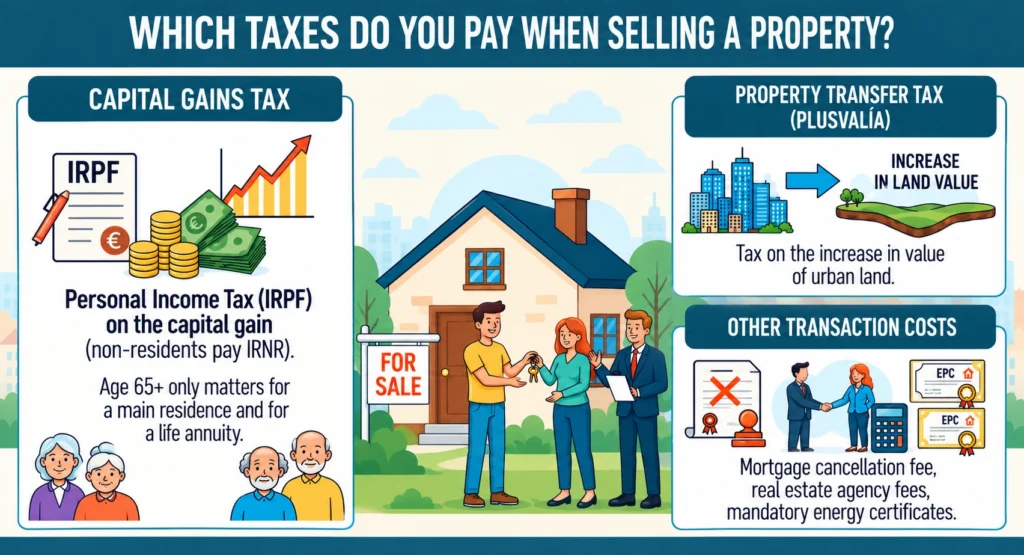
Once you put your property on the market and find a buyer, the excitement of the sale usually comes with a number of tax and administrative obligations. It is important to know what to expect from the outset:
- Personal Income Tax (IRPF) on the capital gain: This is the tax charged on the profit you make from the sale (if you sell the property for more than you paid for it). This is precisely where age can play a particularly important role.
- Municipal capital gains tax (plusvalía municipal): formally known as the Tax on the Increase in Value of Urban Land (IIVTNU), this tax may apply to the increase in the value of urban land that becomes apparent when a property is transferred. Whether it applies and how much is payable will depend on the specific circumstances and the tax regulations of the relevant local council.
- Other costs associated with the sale: these may include removing a mortgage from the Land Registry, estate agent fees and the documentation required to complete the sale, such as the energy performance certificate and, where applicable, the certificate of occupancy. If the seller is not tax resident in Spain, the relevant Non-Resident Income Tax obligations must also be taken into account.
Bear in mind that the tax advantages available to those over 65 mainly affect Personal Income Tax (IRPF), but they do not automatically exempt you from municipal capital gains tax, the costs associated with the transaction or any other applicable tax obligations.
2. How is the capital gain calculated?
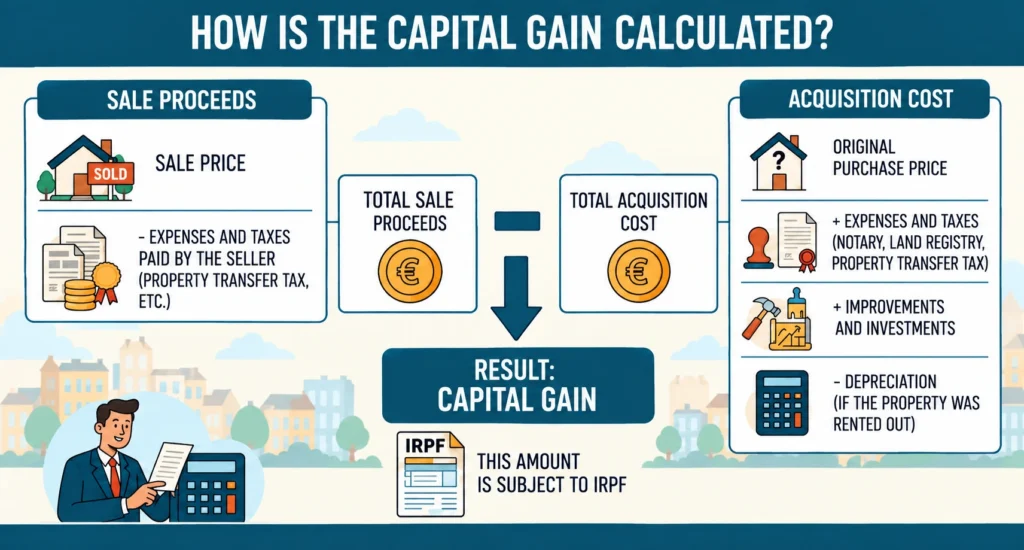
To understand how much tax you may have to pay (or may be exempt from paying), you first need to understand exactly what a capital gain is. The Spanish Tax Agency does not apply Personal Income Tax directly to the total sale price. Instead, it is calculated on the difference between the transfer value and the acquisition value, after applying the adjustments established by law. The basic calculation involves comparing the transfer value (the sale price minus any expenses and taxes directly related to the transfer that you paid as the seller) with the acquisition value (the original purchase price, to which taxes and expenses associated with the purchase and the cost of any qualifying improvements may be added, provided these can be properly documented). If the property was rented out, the acquisition value must be reduced by the tax-deductible depreciation, even if this was not correctly applied in the relevant tax returns. Ordinary repairs should not be confused with improvements, as they do not always have the same effect when calculating the acquisition value.
3. Selling a property before the age of 65
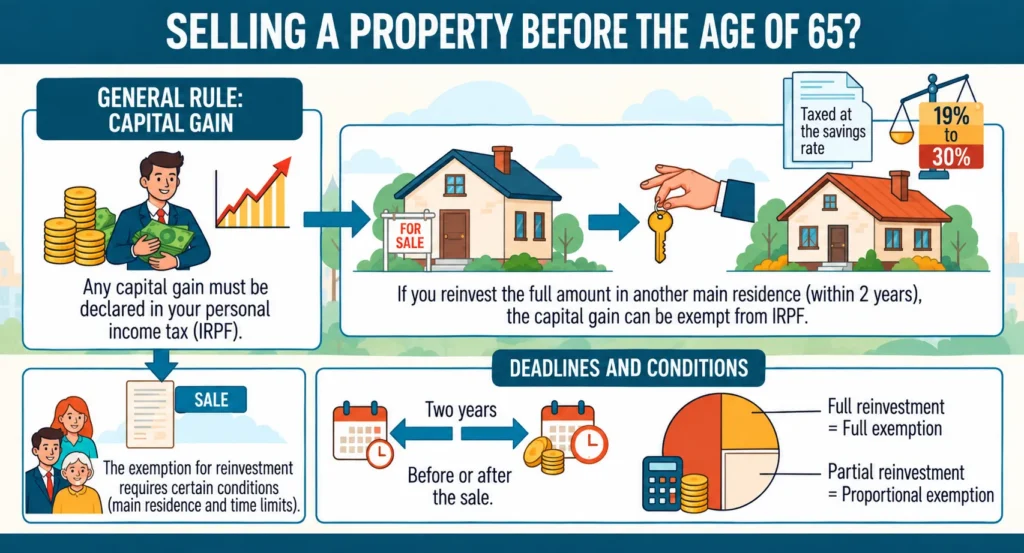
If you have not yet reached the age of 65, the standard rules apply. As a general rule, any capital gain must be declared for Personal Income Tax (IRPF) and will be taxed as savings income, according to the applicable rates and the amount of the gain. One of the main tax reliefs available at this stage is the exemption for reinvesting the proceeds in a new main residence. If the amount obtained from the sale is reinvested in the purchase or renovation of another main residence, the reinvestment exemption may apply, provided all legal requirements are met. However, the rules regarding deadlines are strict: as a general rule, the reinvestment can take place within the two years before or after the sale. If you reinvest only part of the proceeds, the exemption will apply proportionally. Both the property sold and the new property must meet the tax requirements to qualify as a main residence.
4. Selling your main residence after the age of 65
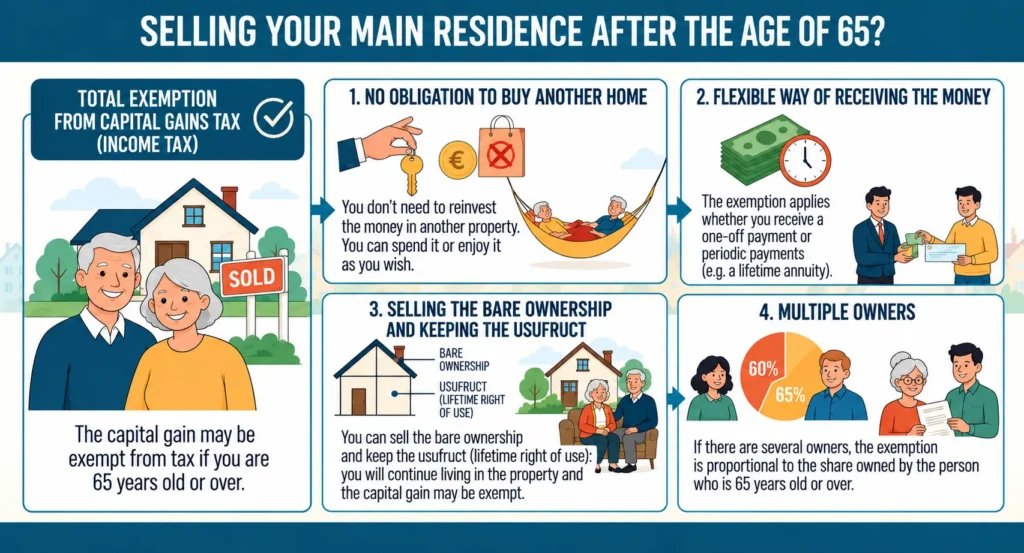
This is where the situation changes significantly. If you are aged 65 or over and sell your main residence, the capital gain may be fully exempt from Personal Income Tax (IRPF), provided all legal requirements are met. You do not need to reinvest the proceeds in another property to qualify for this exemption, although the requirements relating to your age, your main residence and the way the property is transferred must be met:
- No requirement to buy another property: You are not required to reinvest the money in another property or make a new purchase. The proceeds are yours to spend or save as you wish.
- Flexible payment arrangements: The exemption may apply whether you receive a lump sum or the transfer is structured through certain types of income arrangements, provided the relevant requirements are met.
- Bare ownership and usufruct: The exemption may also apply if you transfer the bare ownership of the property while retaining a lifetime usufruct, provided you are the owner of the main residence and all legal requirements are met.
- Multiple owners: Take particular care if the property has more than one owner. Eligibility for the exemption must be assessed separately for each owner and, where applicable, will only apply to the share belonging to the person who meets the requirements. The exemption does not automatically extend to the shares belonging to other co-owners who do not meet the relevant conditions.
5. What counts as your main residence?
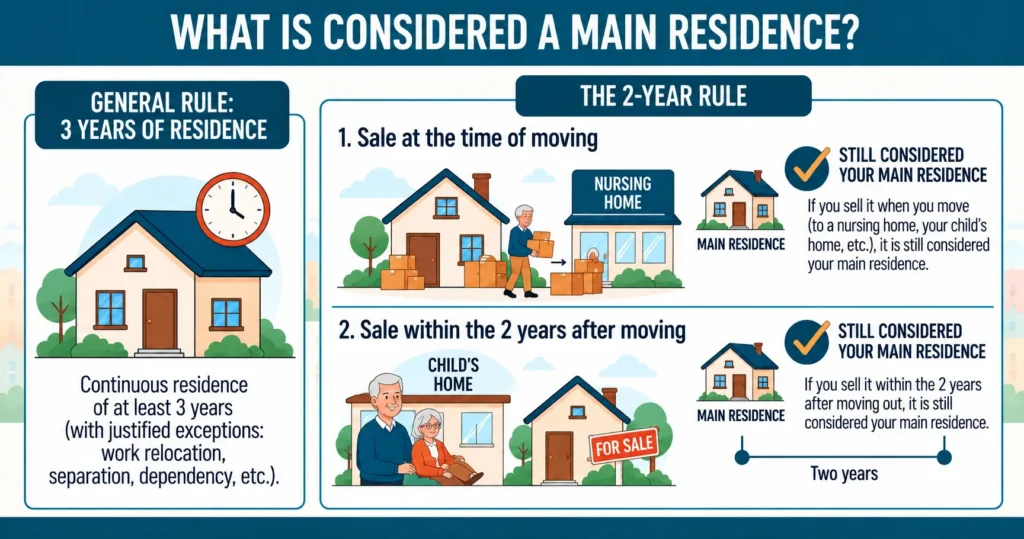
This is one of the concepts that generates the most questions (and confusion) when dealing with the Spanish Tax Agency. As a general rule, for a property to be considered your main residence for tax purposes, you must have lived there continuously for at least three years. There are, however, some important nuances. What happens if you move into a care home or move in with one of your children before selling? The regulations include a specific rule for this exemption: a property may still be treated as your main residence if it qualifies as such at the time of the sale or if it did so at any point during the two years immediately preceding the sale. Moving into a care home or a relative’s home does not, in itself, guarantee that the exemption will apply; all the other tax requirements must also be met.
6. What happens with second homes and rented properties?
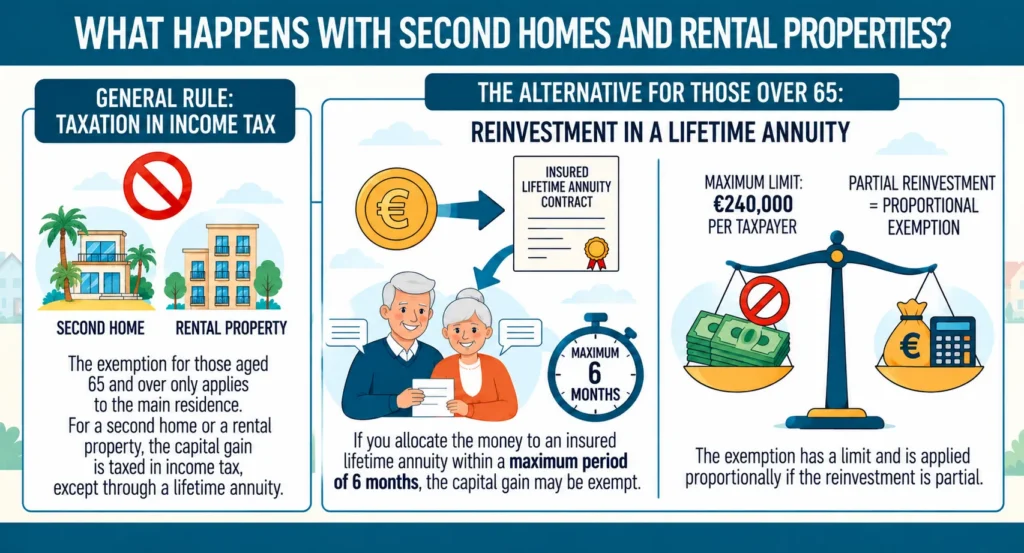
A common misconception is that simply turning 65 means that any property you sell automatically becomes tax-free. If you sell a second home, a holiday property you used during the summer or a flat that you rented out, the capital gain may still be subject to Personal Income Tax (IRPF) under the standard rules, even if you are over 65. However, there is another potentially valuable option for people over the age of 65 who decide to sell these secondary properties: reinvesting the proceeds in a life annuity. If you use the proceeds from the sale to set up an insured life annuity in your favour within the legal six-month period, you may qualify for a full or partial exemption on the capital gain, provided you meet all the other requirements established by law (subject to an overall maximum limit of €240,000 per taxpayer, rather than per property or transaction). If the amount invested in the life annuity is lower than the proceeds from the sale, the exemption on the capital gain will apply proportionally.
7. Taxes and costs that do not disappear when you turn 65
Even if you are exempt from Personal Income Tax when selling your main residence after the age of 65, there are still a number of costs you may need to budget for:
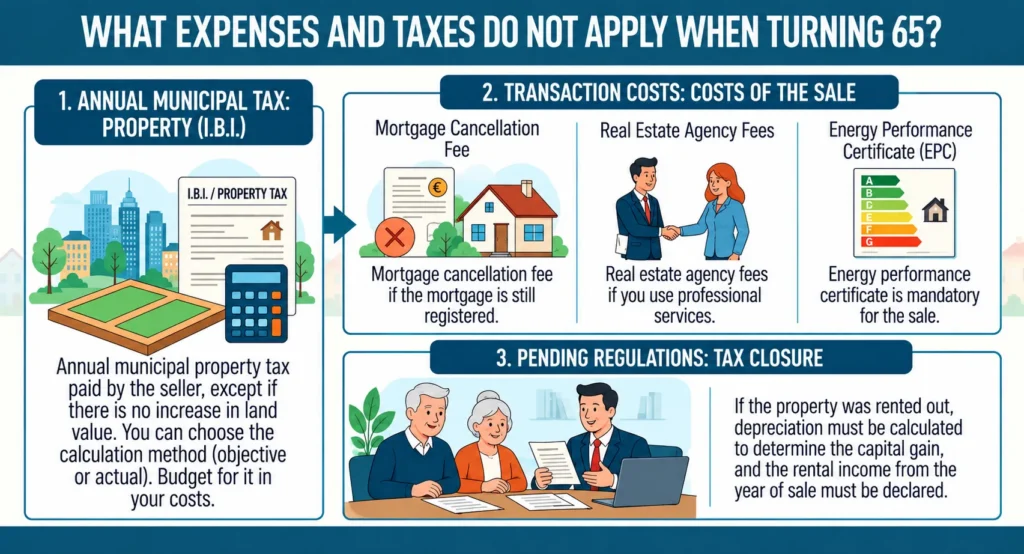
- Municipal capital gains tax (plusvalía municipal): this may be payable when urban land is transferred and the requirements of the IIVTNU are met. It does not automatically disappear simply because you are over 65. It is also not necessarily payable in every case: among other circumstances, the tax may not apply if it can be demonstrated that there has been no increase in the value of the land. In Barcelona, the local tax regulations and the specific circumstances of the sale should be reviewed.
- Transaction costs: These may include removing the mortgage from the Land Registry if the property was purchased with a loan and the mortgage is still registered, estate agent fees if you use professional services, the energy performance certificate and, where applicable, any other documentation required to complete the sale.
- Outstanding tax adjustments: If the property was rented out in the past, you will need to review those periods carefully, including any depreciation, expenses or tax reductions applied in the corresponding tax returns.
8. Practical example: selling before or after turning 65
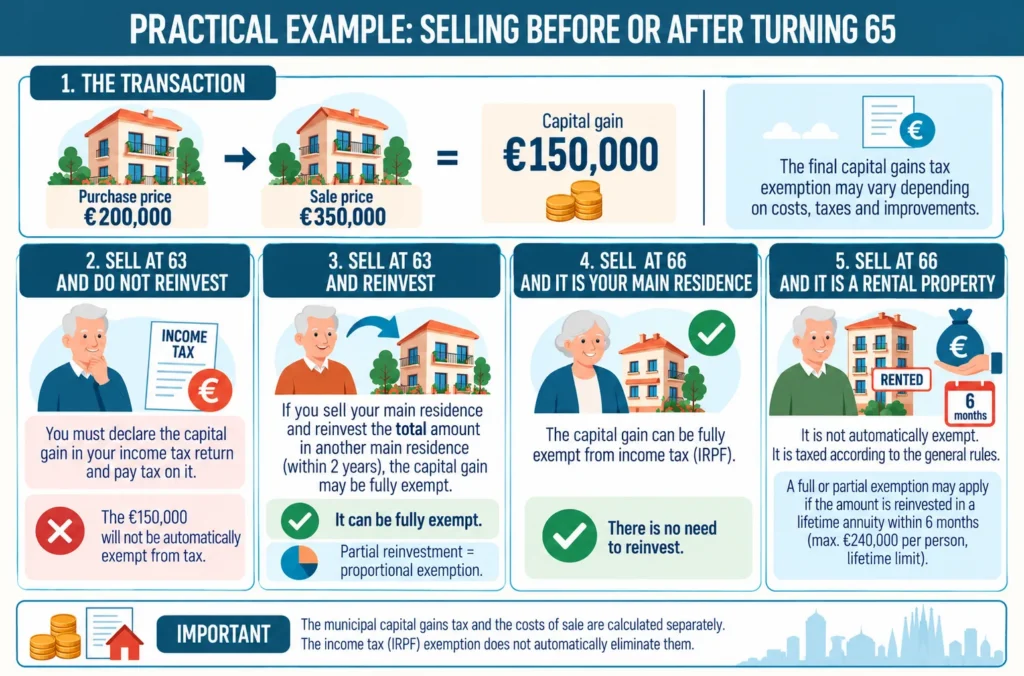
Let’s look at a simple example. A homeowner bought a property for €200,000 and later sells it for €350,000. For illustrative purposes only, the initial difference between the two amounts is €150,000. The final taxable capital gain may change once purchase and sale expenses and taxes, documented improvements and, if the property was rented out, tax-deductible depreciation are taken into account.
- If they sell at the age of 63 and do not reinvest: if the property was their main residence, they will need to declare the capital gain for Personal Income Tax (IRPF) and pay tax on any part not covered by another applicable exemption or offset. In this example, the €150,000 would not automatically be exempt simply because of the owner’s age.
- If they sell at the age of 63 and reinvest the €350,000: if the property sold was their main residence and the full proceeds are used to purchase or renovate another main residence within the legal timeframe, the capital gain may be fully exempt under the reinvestment rules. If only part of the proceeds is reinvested — for example, €200,000 — the exemption will apply proportionally to the amount actually reinvested. The reinvestment can take place within the two years before or after the sale, provided all other requirements are met.
- If they sell at the age of 66 and the property is their main residence: the capital gain corresponding to their ownership share may be fully exempt from Personal Income Tax (IRPF). In this case, there is no need to reinvest the €350,000 in another property or provide evidence of reinvestment in order to qualify for this exemption, provided the age and main-residence requirements are met.
- If they sell at the age of 66 and the property was rented out: the capital gain is not automatically exempt simply because the owner is over 65. In principle, it will be taxed under the standard Personal Income Tax rules. However, a full or partial exemption may be available if the proceeds are used to set up an insured life annuity in the seller’s favour within six months and all other legal requirements are met, subject to an overall maximum limit of €240,000 per taxpayer.
In all of these scenarios, any municipal capital gains tax and the costs associated with the sale must be calculated separately, as the Personal Income Tax exemption does not automatically remove these obligations.
Before making a final decision and signing the sale before a notary, it is worth looking carefully at your individual circumstances. The exact date of the sale may have tax implications, although the final outcome will also depend on factors such as ownership, how the property has been used and whether all the relevant legal requirements are met. Age, therefore, is not the only factor that matters.
Reviewing the ownership structure, the actual use of the property, the dates on which it ceased to be your main residence and any depreciation claimed is essential to avoid unpleasant surprises. In Barcelona, it is also important to consider municipal capital gains tax separately, as well as the documentation required to complete the sale. If you are thinking of selling, having your individual circumstances assessed beforehand could save you a great deal of trouble later on.
Still unsure how these rules might affect your particular situation? Leave us a comment or get in touch with our team of experts; we’ll be happy to help you work through the figures.